


McDermott+ is pleased to bring you Regs & Eggs, a weekly Regulatory Affairs blog by Jeffrey Davis. Click here to subscribe to future blog posts.
May 7, 2026 – One of the most significant provisions in the One Big Beautiful Bill Act (OBBBA), enacted on July 4, 2025, was a mandate that states impose work requirements within their Medicaid programs. Overarchingly, Medicaid work requirements require specified Medicaid enrollees to work, volunteer, participate in a work program, or conduct another qualifying activity (e.g., education, caretaking) as a condition for Medicaid coverage. The OBBBA mandated that states begin implementation by January 1, 2027, but allowed states to start earlier if they wished. A few states have taken (or plan to take) Congress up on that offer and have started the implementation process, even before the Centers for Medicare & Medicaid Services (CMS) has finished putting out the regulations and guidance around the OBBBA requirement.
To help me describe states’ early actions and how these states may impact CMS’s rulemaking and guidance, I’m bringing in my colleagues Maddie News and Katie Waldo.
Work requirements aren’t a new concept. Before the OBBBA was signed into law, certain states had already expressed interest in implementing work requirements. Georgia, for example, had already been operating a work requirement Section 1115 waiver, and other states were pursuing or considering implementing work requirements. In January 2018 (during the first Trump administration), CMS issued guidance inviting states to request Section 1115 waivers that impose work and reporting requirements (referred to as “community engagement requirements”) as a condition of Medicaid eligibility for nonelderly, nonpregnant adult beneficiaries who are eligible on a basis other than disability. The fiscal year 2021 president’s budget formally asked Congress to modify the Medicaid program to require able-bodied, working-age individuals to find employment, train for work, or volunteer (community service) to receive Medicaid coverage.
The OBBBA included general parameters for the work requirements, but CMS still must establish more definitions and overarching rules in an interim final rule by June 1, 2026 (more on that below). Because of the nature of the Medicaid program, states will have some discretion in creating work requirements policies that best meet their individual needs, as long as they follow CMS’s regulations. CMS issued preliminary guidance on work requirements implementation in December 2025 and announced pledges from vendors to support state implementation and other system improvements.
Work requirements under the OBBBA will apply to able-bodied adults, aged 19 to 64, without dependents, targeting the Medicaid expansion population. Individuals must show at least 80 hours per month of work, community service, or participation in a work program; a monthly income equivalent to at least minimum wage for 80 hours; or part-time enrollment in an educational program. An individual could combine any of the work or community service activities to meet the 80-hour-per-month requirement. A seasonal worker could also meet the requirement by having an average monthly income over the past six months that is greater than minimum wage multiplied by 80 hours.
The OBBBA allowed for major exemptions, including:
A state may also (but is not required to) exempt an individual for a month because of a short-term hardship event, which could include the following:
The key term within the exemptions that needs defining is “medically frail.” If it is defined broadly, it could wind up excluding many patient populations from the work requirements. Stakeholders and patient advocacy groups have been urging CMS to include specific conditions or symptoms under this definition to exempt certain population groups from work requirements. We should expect to see more information on how to address and define “medically frail” in the interim final rule.
For individuals applying for Medicaid coverage, states must verify their compliance with the work requirements for at least one month, but not more than three consecutive months, immediately preceding the month during which the individual applies for coverage. For individuals renewing Medicaid coverage, states must verify their compliance with the work requirements during their regularly scheduled redetermination, but a state may also choose to verify compliance more frequently.
In a survey of the 43 state Medicaid programs that must implement work requirements because of their Medicaid expansion, KFF found that two states (Indiana and Iowa) noted their intention to use a three-month look-back period when an individual applies for Medicaid, 36 states planned to use a one-month period, and the remaining five states were uncertain. Only Arkansas plans to use a three-month look-back period at renewal. The OBBBA requires states to use existing data available to the state to verify compliance, and then requires states to reach out, a practice known as data matching. The KFF survey found that states plan to use existing data sources, such as state unemployment data, or new data sources, such as state university enrollment data, before engaging with a beneficiary.
The OBBBA created an aggressive timeline for implementation, with multiple steps necessary before the January 1, 2027, deadline. States could begin implementation as soon as they wanted after the OBBBA was signed into law. In less than one month (June 1, 2026), CMS must put out an interim final rule to implement the work requirements mandate. That rule is currently at the Office of Management and Budget for review. Interim final rules can circumvent the normal rulemaking process. While agencies can seek comment on issues in interim final rules, the policies can go into effect immediately, without first being included in a proposed rule and then a final rule.
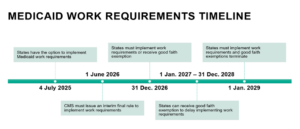
While many states are waiting for CMS to lay out the full requirements in the interim final rule, Nebraska wanted to get a head start, and the state’s work requirements became operational as of May 1, 2026. By going first, Nebraska shared its answers to the outstanding operational and policy questions described above, such as what counts as an exemption and how often the state will conduct verifications. For example, the state reviewed thousands of medical diagnosis and procedure codes in order to develop a list of codes that qualify an individual as “medically frail” and therefore exempt from work requirements. Nebraska plans to revisit and update the list as implementation begins and federal direction is provided.
Nebraska is not the only state implementing work requirements early. According to the KFF survey, Montana aims to implement work requirements on July 1, 2026, and Iowa plans to begin December 1, 2026. Arkansas plans to soft launch work requirements July 1, 2026, but will not implement penalties until January 1, 2027. Any state that implements before the CMS interim final rule is released may need to assess its programs and make modifications to comply with federal requirements.
States and stakeholders are watching for the release of the interim final rule to analyze how CMS approaches the medical frailty exemption, self-attestation, vendor partnerships, outreach to beneficiaries, and other issues. From there, we will need to see whether states that are further along in their implementation efforts have to make adjustments to conform to the rule’s policies.
Until next week, this is Jeffrey (and Maddie and Katie) saying, enjoy reading regs with your eggs.
For more information, please contact Jeffrey Davis. To subscribe to Regs & Eggs, please CLICK HERE


