


McDermott+ is pleased to bring you Regs & Eggs, a weekly Regulatory Affairs blog by Jeffrey Davis. Click here to subscribe to future blog posts.
July 23, 2026 – Last week’s Regs & Eggs took a big bite out the calendar year (CY) 2027 Medicare Physician Fee Schedule (PFS) proposed rule, the major Medicare payment rule impacting physician and other clinician payments. As discussed, one of the major themes in the rule was trying to move more Medicare payments towards value-based care, and a significant set of policies that the Centers for Medicare & Medicaid Services (CMS) proposed around this theme were modifications to the Medicare Shared Savings Program (MSSP). The MSSP is the national accountable care organization (ACO) program that was initially created under the Affordable Care Act (ACA). Since the passage of the ACA, the MSSP has grown significantly and now encompasses 511 ACOs with more than 700,000 healthcare providers and organizations providing care to more than 12.6 million beneficiaries. To help me dig into the MSSP proposals in the CY 2027 PFS rule – and how these changes fit into CMS’s larger ACO and value-based care strategy – I’m bringing in my colleague, Simeon Niles.
CMS has long believed that ACOs have the potential to improve care coordination, lower overall healthcare costs, and improve quality of care and overall value in the healthcare delivery system. While the MSSP is a national program, CMS has also tested various ACO models in the CMS Innovation Center, including, most recently, the ACO REACH Model. That model ends at the end of this year, and the Innovation Center has announced a new model, called the Long-term Enhanced ACO Design (LEAD) Model, that will begin next year. Each CMS Innovation Center shared savings model and the MSSP have tested various design features of a shared savings/shared losses construct, where an ACO is able to share in savings (or, if applicable, owe money back to CMS) if its total Medicare spending during a performance period was higher (or lower) relative to a spending benchmark. There are many ways to design an ACO, with different approaches to assigning Medicare beneficiaries to ACOs, establishing and updating a spending benchmark, calculating and determining actual spending, and measuring quality of care. As CMS has gained more experience testing ACO models and running the MSSP, it has continued to tweak features in both the models and the MSSP itself.
Updates to the MSSP are now routinely found in each PFS rule, so it is not surprising that there are MSSP-related proposals in the CY 2027 PFS proposed rule. However, what is noteworthy is the breadth of those proposed changes. The MSSP proposed changes span more than 300 pages of the rule and truly address every aspect of the program. Many of the changes appear to directly respond to issues that certain stakeholders have raised.
Here are five key MSSP proposals from this year’s proposed rule:
ACO REACH introduced Medicare ACOs to the world of full risk (i.e., 100% shared savings/losses), and so far it’s paid off. According to 2024 ACO performance data released by CMS on July 9, 2026, ACOs participating in REACH’s full-risk option, Global, generated more than double the amount of gross savings and ACO earnings than ACOs participating in the lower-risk option, Professional (see table 1 below).
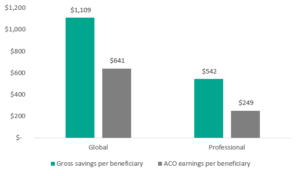
Source: PY2024 ACO REACH Financial and Quality Results.
As such, many REACH ACOs were hoping to see this risk-sharing option make its way over to MSSP, where it would become a permanent part of Medicare, and not exist just as a model test. However, in the proposed rule, CMS states that ACOs in BASIC track Level E generate higher net savings for Medicare than ACOs in the ENHANCED track despite generating lower gross savings because more of those savings (i.e., 75%) are paid back to participating ACOs. Rather than a full-risk option, CMS opted to increase the savings rate for BASIC track Level E from 50% to 60% for agreement periods beginning on or after January 1, 2027. CMS believes that if it closes the gap between the sharing rate of the ENHANCED track (75%), fewer MSSP ACOs would transition to the ENHANCED track and instead more would transition to BASIC track Level E, yielding additional net savings for Medicare due to the lower sharing rate.
Probably one of the most significant proposals this year involves the ACPT. CMS introduced the ACPT in CY 2023 to help project, more accurately, Medicare cost growth when setting ACO benchmarks. But since 2024, the ACPT has underestimated actual cost growth, eating away at the shared savings earned by impacted MSSP ACOs. The CMS Innovation Center recognized this risk and plans to implement guardrails in LEAD. And now, MSSP will do the same.
For agreement periods beginning on or after January 1, 2027, CMS proposes to calculate and publicly report the United States per capita cost (USPCC) modified annualized growth rates applicable to that performance year, instead of calculating a fixed five-year schedule of annualized growth rates at the start of an ACO’s agreement period. CMS also proposes to establish an asymmetric guardrail to limit how much the modified USPCC annualized growth rates can differ from the observed cumulative growth in national assignable expenditures. Under this proposal, the modified USPCC growth rate cannot fall more than one percentage point below or rise more than 1.5 percentage points above actual observed spending growth for each of the end-stage renal disease population and the aged/disabled population.
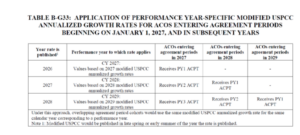
Table B-G33 from the proposed rule illustrates the timeline for publishing these growth rates, if finalized. For performance year (PY) 2025 and PY 2026, CMS proposes to apply the one percentage point limit retroactively where the modified USPCC cumulative growth rates are substantially lower than observed cumulative growth in national assignable expenditures.
To help grow MSSP, CMS proposes to introduce a growth adjustment to an ACO’s historical benchmark as the product of the ACO’s “new growth” share and the incentive factor for ACOs in agreement periods beginning on January 1, 2027, and in subsequent years. For the purposes of this proposal, “new growth” means the number of beneficiaries that are new to MSSP that are brought into the program by ACO professionals who are inexperienced in shared savings initiatives (i.e., have not participated in MSSP or an Innovation Center ACO model in any of the five performance years directly preceding the start of the ACO’s current agreement period).
The proposed incentive factor would be 5% of the per-capita historical benchmark added to the highest of the positive regional adjustment, prior savings adjustment, and population adjustment, or no adjustment. The total amount would be capped at 5% of national per-capita Medicare fee-for-service (FFS) expenditures.
CMS also proposes a number of changes to the Alternative Payment Model Performance Pathway (APP)/APP Plus measure set and other quality reporting requirements designed to help the industry make the transition to digital quality measures (dQMs), a longstanding goal of the agency. In particular, CMS proposes to extend the availability of the Merit-based Incentive Payment System clinical quality measures (MIPS CQMs) collection type for PY 2027 and subsequent PYs to allow MSSP ACOs to focus their resources on the transition to dQM reporting. CMS also proposes to extend the MIPS CQM reporting incentive, which helps MSSP ACOs become eligible for maximum shared savings or avoid maximum shared losses. CMS anticipates sunsetting the MIPS CQM reporting incentive after a two-year transition period beginning with PY 2028. Beginning in PY 2030, CMS proposes that fast healthcare interoperatbility resources (FHIR)-based reporting would become mandatory for all electronic CQMs (eCQMS) and proposed Medicare eCQMs.
CMS proposes changes to beneficiary engagement flexibilities to improve outcomes and reduce burden. One such flexibility is allowing ACOs, in partnership with willing ACO participants, to reduce or eliminate beneficiary cost-sharing for all Medicare FFS Part B items and services (except prescription drugs and durable medical equipment, prosthetic devices, prosthetics, orthotics, and supplies) for assigned beneficiaries whose overall health is expected to be improved or maintained by receiving the associated Part B item or service. If finalized, CMS would make available the CMS-sponsored models safe harbor to allow for Part B cost-sharing support arrangements between the ACO and the ACO participant, and patient incentives in the form of Part B cost-sharing support furnished to eligible beneficiaries.
The proposed rule includes requests for information (RFIs) relevant to MSSP, where CMS is seeking to improve specialist engagement and implement electronic prior authorization (ePA) measures:
There are certainly enough MSSP proposals for all stakeholders to chew on. Taken together, these policies reflect a program that CMS is actively trying to grow through incentives, maintain through incorporation of stakeholder feedback, and innovate within to improve beneficiary engagement, quality, and – ultimately – health outcomes. CMS is accepting public comments until September 14, 2026, and will likely finalize some or all the proposals in the CY 2027 PFS final rule issued by November 1, 2026.
Until next week, this is Jeffrey (and Simeon) saying, enjoy reading regs with your eggs.
For more information, please contact Jeffrey Davis. To subscribe to Regs & Eggs, please CLICK HERE.


